Showing posts with label chickens. Show all posts

Thursday, April 7, 2011

So long, pullets

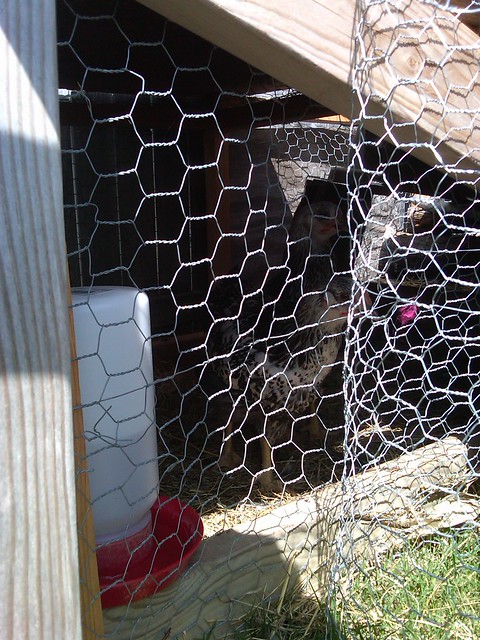
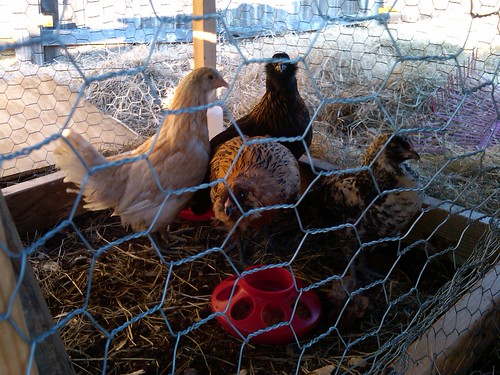
The last of the illegal chickens are leaving today.  It'll be sad to see them go, but it was fun to raise these little ladies from a day old.  I can't believe when we got them, they were the size of a tennis ball.  Here's a few pics before they leave.

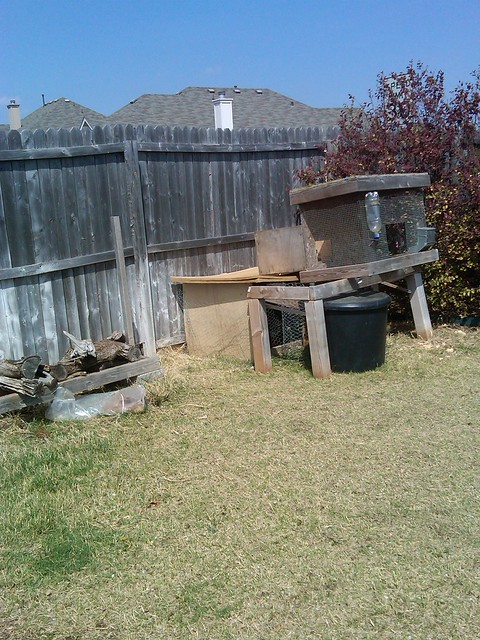
(The chickens secret pen which hides them pretty dang well)

Bye ladies!

Monday, February 28, 2011

And to end February

February went out with a bang today, ending our weeks of 60s/70s temperature by getting down to 34 last night.  One last horrah.  Thank you February :-)

I have been reading through an incredibly detailed, incredibly useful link on Poultry.  There is a lot more info than just poultry, but I'm not ready for that stage.  Here's the link, start reading!

http://www.themodernhomestead.us/article/Poultry.html

I got in all my seeds over the weekend.  All I lack now is the strawberry plants (set to come in & be planted this week), and I'll be all set.  Also, 2 of the pullets will be going to live on a farm - literally, not metaphorically - today, and another 2 will be going to live with Tara at another time shortly. 

The last thing for the week, probably, will be the renting of a rear-tine tiller from Ace Hardware.  My front-tine tiller broke again, and I'm just tired of dealing with it.  You can't beat $8 to rent a $400 tiller!

See you in March!

Thursday, February 17, 2011

Shh!

"We're not supposed to be here!"

Sunday, July 18, 2010

Getting ready!

I picked up a landscape edger today, and ordered the landscape fabric.  I have finally done it; I've created the perfect garden!  Haha, well maybe not.  But it is a pretty good design, if I say so myself, and at least it fits my yard/slope/location well.  Below is the layout of my garden.  It didn't scan well because pencil & paper isn't the clearest thing in the world.  Oh well.

Click to Enlarge
From Blog Photos


Some things I have written on the bottom of the picture:

245 Corn plants
110 Bean plants
5 Blackberry plants
5 Raspberry plants
45 Potato plants
22 Pepper plants
16 Tomato plants
7x5 Strawberry bed (not sure on # of plants)

Also scattered throughout the garden I will have lots of Onions, Borage, Carrots, Marigolds, Nasturtiums, and anything else I can think of that will keep pests away.  If you haven't looked into Borage, do it!  That stuff is amazing!

Not much new on the chickens.  I did talk to a realtor who kind of gave me half of what I was looking for.  She did write that a maintained coop would not cause the resale value of a nearby house to drop.  That's good info.

Wednesday, July 14, 2010

100th blog post

Took a while longer than I had hoped, but here it is: the 100th blog post. 

I've been monitoring the corn pretty closely lately.  I picked an ear today, but it very small and not done.  I also picked several carrots and a funky looking cucumber.   The cucumbers did not pollinate well (nearly at all), so I went out with a little paintbrush and pollinated them by hand.  Not sure how it will turn out, but hopefully well.

There is also some really big news on the horizon!  I'm currently writing up a paper which I will be presenting at our HOA meeting.  I'm both terrified and excited.  I have a lot of points I would like to cover, but due to time constraints, I have 4 main ones.  Here's the paper/outline below.  It's not completely done, but mostly.

___________________________________________________________


Raising Chickens
Introduction

Noise

On a normal day, in our neighborhood, we hear helicopters, airplanes, dogs barking, children, cars and trucks driving by, sprinklers, lawnmowers, and sounds from the pool and the park.

A hen produces very little noise.  Normally people think of the morning crow of a rooster, however, these are not allowed in Arlington.  A hen makes a soft clucking noise, which is not usually audible beyond 25 ft.  The loudest a hen gets is after laying an egg – which occurs one time a day (or less) for a few minutes.

Smell

Chickens themselves do not smell.  Chicken manure does have the potential to smell, which is also true of cats, dogs, and other pets.

A medium-sized dog will generate, on average, 0.75 lb. of manure or feces a day.  A medium sized (4 lb.) hen generates, on average, 0.05 lb. per day.  Obviously, with Arlington’s maximum of 4 chickens (0.20 lbs./day), this would still pale in comparison to the amount of feces a dog produces. 

In addition, a dog’s waste contains harmful bacteria and parasites, such as roundworms, tapeworms, and hookworms.  Chicken waste is “compostable” unlike other pet manures, which means it will easily and safely break down organically into the Earth.

Why do people think of odor when they think of chickens?  This answer could vary greatly, but the most likely answer is because many of us have been to a farm or large commercial operation where chickens are processed.  Many of these places are poorly-ventilated, crowded, and not maintained properly.

Arlington Ordinances and Structure
Section 5.02 Keeping of Fowl
A person commits an offense if he:
A. Keeps or maintains more than four (4) fowl on one-half (1/2) acre or less or at a distance closer than fifty feet (50') from any habitation located on another's property; or
E. Fails to keep any fowl of the Order Galliformes [this includes chickens] contained within a coop or pen.
F. Keeps or maintains roosters except in an area zoned as agricultural.
Basically:
A person cannot have more than 4 hens on ½ acre or less.  They must keep the hens 50’ away from a house on another person’s property.  They must be contained within a coop/pen.  And last, no roosters!


The structures above are clearly small.  Chickens require very little space to roam and sleep.  An average sized doghouse is plenty big enough for multiple hens to sleep in, and a hen needs about 6-8 square feet of roaming space.  This is smaller than a 3’ x 3’ fenced in section – incredibly small.

Property Values
Here I will be placing several (2 or 3) letters from local Realtors stating chickens are no more negative to a property-value than a poorly maintained dog house, etc.

Closing
Raising hens offers our neighborhood a unique opportunity to raise animals which are intelligent, social, entertaining, low-maintenance, clean, and quiet.  They’re quieter than nearly every noise we hear through our community, and cleaner than most family pets. 
Most everyone here cares for this community and shows it by maintaining the neighborhood and keeping it beautiful.  I wouldn’t expect that with raising hens it would be any different, so I ask you all to consider overturning the HOA regulations on prohibiting chickens.


Appendices
Appendix A:
Suggested Additional Ordinances
a.       No coop shall exceed 6 feet above grade and must allow for a footprint of at least 2 square feet per chicken housed in the coop.  The maximum single coop footprint size is 40 square feet.  Coops must be located in the rear yard of the lot.  Coops must be kept clean, sanitary, and free from standing water at all times.
b.      Maximum number of chickens allowed per residential lot is 4 hens.  No roosters are permitted.


So, as you can see I have some work to do, but hopefully it'll go over well.  I'm appalled by some of the great papers people have written and put online.  Using that info and my own, maybe I can channel debate from high school and come out on top.  

Saturday, May 22, 2010

Processing a Chicken, part 2.

Caution: there are some graphic photos.  If you're not interested in seeing them, don't scroll down.

It was time for round 2:


The thirteen remaining chickens sat in their pen, quite a bit larger than the last time we saw them...which was weird, because it had only been 1 week.


Into the holding pen they go, and they were none too thrilled.


But, they're really not that fast.  3 were quickly secured by zip-ties around their legs.


Sister is helping too!


You put each chicken in a "cone" made of sheet metal, upside down.  It keeps them from flapping around.  Also, it drains the chicken of blood which is not only cleaner, but safer regarding bacteria.  Woot.


You cut their neck, swiftly.  It kills them instantly, though the body jolts around for a few seconds due to involuntary muscle spasms dealing with the nervous system.  I'm not a vet, though.  That's just an educated guess.

Somehow we missed getting a picture of the scalder, but you can figure it out.  You dip the dead bird into a giant tub of water around 150 degrees, for a few seconds.  This helps loosen the feathers.

We then plucked the feathers, in a 2-part approach.  We'd run the Clucker Plucker briefly to strip most of the smaller feathers, and then pull the rest by hand.


And as promised to so many people (cough cough, family members who doubted this would ever work, cough cough) video proof.


Though I will say, this was one of the first times we used it, and it took me a few tries to get it right.  Eventually I'd have the whole bird done in ~30 seconds or less.

Next was the eviscerating.  The basic approach was:
1) Cut off head
2) Cut off feet at "knee" knuckle-bone.
3) Separate membrane around neck and crop, esophagus, and trachea
4) Cut below keel bone and open to inside of chicken.  Work hands (carefully!) around innards pulling them away from membrane lining.
5) When innards are loose from inside, pull out through the open area you cut above.  If possible, pull crop along with tubes.  If not, cut them and pull them from the top.
6) Leave everything still attached, and cut tail off.  Be sure not to hit gland inside tail.
7) Cut out gizzard, heart, and livers.  Be extremely careful not to nick the gall bladder.  If you do, green bile will pour out all over the place, and anything it touches is ruined.
8) Pull lungs out
9) Pull kidneys out.
10) Wash bird and chill.

Part of the eviscerating:


Completed chicken:


Later, I cut up some chicken into pieces, and we had a nice meal :)

Chicken

Wash, rinse, and repeat!

Wednesday, May 19, 2010

Lots to get to

As if anything ever slowed down around here...might take a few sittings to get through this entire post.

Around the Farm:
It has, unfortunately, been over a month since I posted the "Days in the Ground" table.  Feel kind of bad about that.  But anyways, what's done is done, and below are the current stats:


Days in the ground 
Plant  # Days
Lettuce  107
Potatoes  80
Carrots  80
Onions  80
Peas  66
Nasturtiums  66
Tomatoes  49
Bell Peppers  49
Rosemary  49
Green Beans  49
Cucumbers  49
Corn  45
Beans  45
Strawberries  45
Squash  45
Charantais Melon                10


As you can see, the lettuce has been in the ground over 100 days.  The Lettuce has been an interesting adventure.  It began by getting 12" of snow dumped on it, and had some trouble getting going.  But once it did start, it grew very well.  I have learned this year that it grows A LOT better when you give it A LOT of water.  Who'da thunk it?  Even so, it did not perform as well as hoped, with only 3 plants really producing any lettuce of eating size.  The worst news of all is, it didn't really taste good.  I mean, sure Lettuce isn't supposed to taste like a T-Bone steak, but it had a bitter-type taste to it.  Could have also been that the leaf I had was not the freshest, and I normally would eat it with carrots, salad dressing, etc.  I chalk this up to a half-success.  Next year I will grow it in a slightly different location getting better sunlight, and it will be in a cold frame (can't wait to finish building that).

Next, potatoes.  Wow, what a crazy vegetable.  In the Square Foot Gardens (SFGs) I planted 6 total plants - 3 Red Noreland and 3 Yukon Gold.  The Red Norland immediately shot out of the ground, followed a couple weeks later by the Yukon Gold.  I noticed the Red Noreland plants appeared to be turning yellow above ground, and slightly brown/black.  As far as I can tell, this meant they were "done" growing.  The stalks and leaves eventually all shriveled up and died, and when I pulled 2 Red Noreland plants, I had 14 potatoes.  More on that later.  Overall, I think these went pretty well.  Still eager to see how the rest of the potatoes will do.  In addition, I planted 6 "test cases" (3 of each) in a clay filled bed, with really poor soil, and I really did not pay much attention to it, other than watering it when I remembered.  After pulling up 3 of those plants, I found potatoes that were just as good or better than the SFG's.  Needless to say, that was surprising.  Encouraging, though.  Hopefully next year will yield more potatoes per plant, as opposed to 1 or 2 per plant this year. 


The carrots are confusing me.  2 squares, same soil, same water, same location in sunlight.  And yet, one is producing very well, while one is not.  After checking one today, it is about 1/2 the size of my wife's pinky finger - not very big. 

The onions - not too much to say about these.  They appear to be growing well, though I need to dust off the top level of soil so they will expand.

I had a beautiful red bloom on one of the Nasturtiums this morning.  Dang, I really wish I had taken a picture of that.  It's gone now, unfortunately, but it sure looked good!

Tomatoes & Peppers - you suck.  Supposedly easy to grow and very tolerant, they have been a complete failure.  I'm not terribly upset about it though.  This isn't to say they're done for the year, but they are nowhere near where they need to be.
*edit* As I wrote this a few days ago, something amazing happened - two tomatoes showed up!  They really look like peppers, so I'm kind of confused, but I'll let them keep growing and we'll see how they turn out.  Pretty cool :)  Bell Peppers though, are still producing nothing.

Rosemary - Well to be honest, I wasn't even sure if this was planted.  I spilled the seed pack, haha, so I was *hoping* one just happened to land where it needed.  Haven't seen anything.


Beans & Peas - The Green Beans are growing very well, albeit a tad short.  They have just produced runners and starting to climb.  The Peas have been hit by bugs very badly.  They still seem to be growing but it must be hard when you're being targeted above everything else by the insects.  After putting down a fertilizer (more about that later) they SHOT up, from approximately 3" tall to approximately 7" tall in just a few days.  Amazing.

Cucs and Corn - Growing well, but still early.  Eager to see how these turn out.

Strawberries - I don't really know, to be honest.  I still think that I may have just planted a bunch of dead strawberries, but on the other hand, I have a lot of "green stuff" growing there.  It might be weeds.  I have no idea.

Squash - Eh.  I just don't know yet; the verdict is still out.  Some really bad winds broke them over but they appeared to recover.  They have flowered, but they are FAR from the size of other people's plants.  They were planted a tad too late, but they really should be doing better.

Cantaloupes - Just planted these a few days ago.  I put some stones behind the plant so they will absorb some heat, which melons love.  They had a few sprouts, but pests attack one of them.  I can't wait for these.  Really hopeful these turn out well.


Livestock

First off, the rabbit.  I just do not know about this guy.  To be honest it seems like he has turned more into a pet.  Reason being, the manure he produces, when dried and put into the garden, merely attracts TONS of pests and they end up killing plants.  That's definitely not what I wanted.  So, that leaves 1) figuring out what to do with a ton of manure, or 2) breeding him for meat/selling rabbits.

While breeding him with a doe may not be extremely difficult, it's the sweltering weather in Texas I am worried about.  Not to mention needing a market for the rabbit and/or meat, governmental restrictions on selling meat, etc.   Not sure how that would go, but it would be an undertaking to say the least.

Secondly, the meat chickens.  Words can't express how I feel about this.  Literally - I have tried to come up with some.  It just feels so...right.  First off, it was dang cheap, which will surely grab my attention any day.  Secondly, (from what Tara says!) they were fairly easy to raise.  They were humanely raised and humanely killed.  We had our first dinner with the chicken last night, along with some potatoes from the garden.  The chicken tasted amazing.  The potatoes tasted...weird.  It was like tasting a potato for the first time.  When people told me "you will be so surprised how your food tastes straight from the garden" I frankly brushed it off, but wow was I wrong.  The potatoes had an earthy taste, not in a bad way though.  Delicious.  We made some spicier than normal chicken, and it was delicious as well.  Very happy with this :)

I would really like to put up some pictures, but since the last two weeks have been an absolute disaster, in nearly ever aspect, they'll just have to be put up later.  I promise.  As soon as everything cools down.

And last but not least, the great Fence Debacle.  Another 5 fence posts have blown down.  I have now realized I am in the wrong business - you can make a killing off removing fence posts and installing new ones.  Wow.  Unbelievable.  No thanks, I'll just cut my arms into pieces installing my own :-\

Alright, if you haven't been able to tell, this post was written over several days, so it's kind of a conglomeration of crazy stories.  Another one occurred last night, just when I thought it was all winding down.  I went to the garage to turn off the sprinklers for tomorrow (didn't want them to spray on the fence-pulling stuff in the back yard - go figure).  When I went into the garage, I noticed water on the ground.  What could that be?  Then I looked up and saw that my clock was off.  The power had gone out (it's a GFCI outlet, so just the outlet goes out).  Well, I wanted to say a lot of words that shouldn't be said.  I thought them, that's for sure.  I also wanted to punch some things.  Over $200 worth of meat, down the drain.

After cooling off a little (no pun intended), I checked the meat in the freezer, and did some investigation.  It had been approximately 27 hours since the freezer went out.  The meat was still frozen, but it had slightly thawed around the edges.  I think it will be safe, obviously if cooked to the proper temperatures and handed carefully.  Just really, really irks me.
     Then Katie came to my aid.  She pointed out that, on a "real" farm, you might not lose your freezer power to a freak outlet, but you might lose 20 chickens to a coyote.  You might have a herd of animals inflicted with some disease, and you have to kill them all to save themselves.  While mine happened a little farther down the food chain, nonetheless it happened.  Just time to move on and don't give up due to an accident.

Thanks a ton for checking in and reading my blog.
Sunday, May 2, 2010

Processing a chicken, part 1

Wow.

Firstoff, a H U G E  thanks to Tara for taking care of the chickens over the last 12 weeks or so, and for everything she and Jerry taught us yesterday on their farm.  (Love it out there, by the way.  It's awesome)

So the evening beforehand starts off with bad news - the chicken processing would be canceled due to terrible storms and hail.  However, the weather forecasters must have spun their "wheel o' weather" a tad too hard, because it ended up being a dang nice day.  We all went ahead and went out there to begin the process.

After getting everything set up, we corralled the chickens to make them easier to pick up.  We picked 3 big ones and tied their legs to begin the process.  At this point, I must say I wasn't necessarily looking forward to the ensuing mess.  It was obviously going to be bloody and messy, and though I have killed animals before for food, it was using a rifle, not a knife.  Tara showed us how it was done, and believe it or not, it wasn't as bad as I thought it would be.  Sure it was bloody, but it was very humane and clean (relatively anyways).

Next we pulled feathers, and once we figured out how to use the "Clucker Plucker" correctly, it worked phenomenally, if I say so myself :-D .  After that, it was onto the table to clean out the insides, and then into the ice-water bath.  At the end of the day (3 hours) we had done 15 chickens and decided to meet back next Saturday to do the remaining 13 + 3 roosters.  I might have a helper as my sister is awfully interested in learning about it.  Who knows...

Though I do know one thing - I can't wait to cook some of these up!  

Sunday, April 11, 2010

Woodlice, round 2

I have started watering the corn in the mornings, about 10-15 minutes, after removing the wheat straw.  It is working extremely well.  I already have most of the corn shoots up, and several bean shoots are there as well.  I never could find the squash seed packets, so I just bought some plants and planted them. 

I noticed more holes in the potato leaves, so I tried my yeast trick again.  Boil 2 packets of yeast in some water, and then pour it into tin cups which are submerged in the ground, with the lip at ground level.  The woodlice are attracted to it, go over, fall in, and die.  Well, I put those out, and my curiosity got the best of me last night at about 10:15 pm.  I took a flashlight, went and looked, and noticed 1 potato plant COVERED in woodlice, from top to bottom.  I managed to grab a lot of them off, and knock the rest off.  Those little pests.  So, it appears those are the major problem.

I went to Tara's house and got to see the meat chickens!  That was very cool, and after hearing how virtually silent they were, I wonder if anyone would really notice if I had them next year, if I kept them out of view of neighbors.  They might be able to smell them, though.  Hm...something to think about for the next 8 months or so.

I also started "restoring" the old window-panes I got at a flea market.  They'll be used late this year and early next year for cold frames.  They're looking pretty neat :-)

Other than that, not too much news.

Wednesday, January 20, 2010

Chicks!

Some of these guys will be on their way to Tara's house.


Then, around April, we'll head down to butcher them when they're full grown. It may not be raising my own backyard chickens, but it's pretty close.